
The Hair Specialists / Hair education
Hair anatomy & the growth cycle.
Understand how a hair is made, why it grows and sheds, and what those changes can mean for your next steps.
01 / Beneath the surface
A strand is part of a larger structure.
The visible fiber is made inside a follicle in the skin. Understanding both helps separate changes in the hair you style from changes in the structures that produce it.
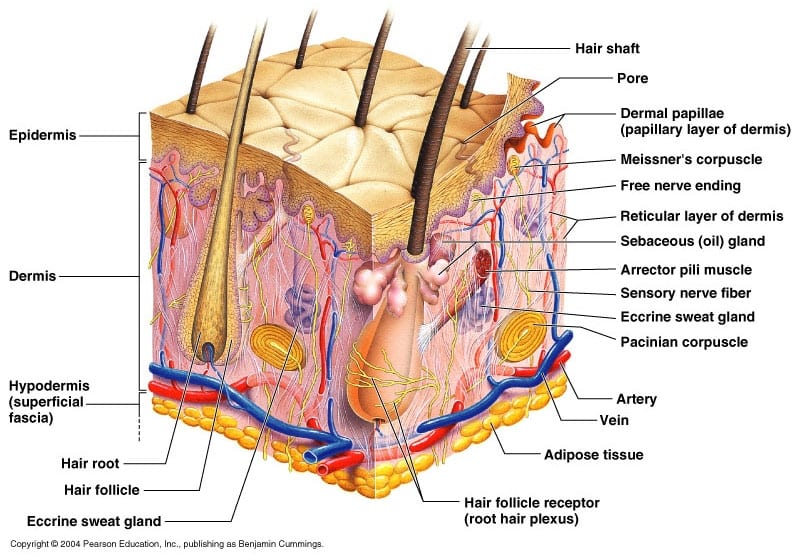
The structures that produce and support a hair.
- Hair shaft
- The strand above your skin consists of keratinized cells. This is the fiber you wash, cut, color, and style. Its appearance can change without changing the way the follicle produces hair.
- Follicle & root sheaths
- The follicle is the living structure within the skin that makes and surrounds a hair. Inner and outer root sheaths support the growing strand; the inner sheath helps shape it.
- Hair bulb & matrix
- The enlarged base contains dividing matrix cells that form the hair fiber. Nearby pigment-producing cells, called melanocytes, supply its color during growth.
- Dermal papilla
- This small structure sits within the bulb. It contains capillaries and exchanges signals with neighboring cells involved in hair production.
- Sebaceous gland
- This gland releases sebum into the follicle. Sebum is the natural oily material that helps protect the hair and skin surface.
- Arrector pili muscle
- This small muscle connects to the follicle. When it contracts, it can raise the hair and produce a goosebump.
- Follicular bulge
- This region contains a reservoir of stem cells involved in follicle renewal. It is separate from the bulb at the bottom of an actively growing follicle.
Sources: StatPearls / NCBI Bookshelf: Anatomy, Hair Follicle · StatPearls / NCBI Bookshelf: Physiology, Hair · StatPearls / NCBI Bookshelf: Anatomy, Hair
02 / Inside the strand
The layers of a hair shaft.
Much of the fiber is keratin, a structural protein. Its microscopic layers contribute to how a strand looks and behaves.
Cuticle
Overlapping cells form the outer covering. Their condition affects the smoothness of the strand’s surface.
Cortex
This layer makes up most of the fiber and contributes substantially to its strength, physical properties, and color.
Medulla
A central region that may be present in thicker hairs. Many fine hairs have little or no medulla.
Sources: StatPearls / NCBI Bookshelf: Physiology, Hair
03 / Growth, transition, rest & release
Explore the hair growth cycle.
Individual follicles cycle at different times. This staggered activity lets your scalp contain growing, resting, and shedding hairs together.
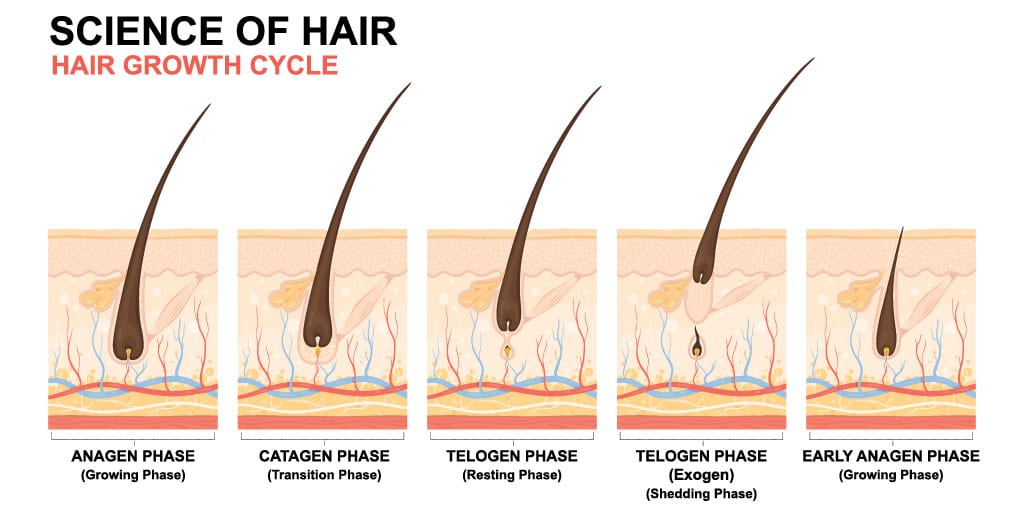
Select a stage to explore it. With a keyboard, use Left Arrow, Right Arrow, Home, or End to move between stages.
Approximate scalp range
The follicle builds a hair.
Matrix cells divide and form a new strand. For scalp hair, this growing period usually lasts years, allowing substantial length to develop.
Scalp hair grows about 1 centimeter per month on average. Your rate and growth-phase length can differ. Eyebrow and eyelash follicles have much shorter growing periods.
Sources: Cleveland Clinic: Hair Follicle · StatPearls / NCBI Bookshelf: Anatomy, Hair Follicle
Often about 2 weeks
The lower follicle regresses.
Active fiber production stops and the lower portion of the follicle shrinks. The hair develops a hardened, club-shaped end as it moves toward the resting stage.
This is a normal part of follicle renewal. The end of one strand’s growing period does not mean that the entire follicle has been permanently lost.
Sources: StatPearls / NCBI Bookshelf: Physiology, Hair · StatPearls / NCBI Bookshelf: Anatomy, Hair Follicle
Timing varies between hairs
The formed hair rests in place.
The existing strand is no longer lengthening. It can remain held in the follicle while the next cycle approaches.
Resting hairs are present alongside growing hairs across a healthy scalp. A change that sends unusually many hairs into rest can become noticeable later as increased shedding.
Sources: StatPearls / NCBI Bookshelf: Anatomy, Hair · British Association of Dermatologists: Telogen effluvium
Not a fixed countdown
The old strand is released.
Exogen describes the release of an old hair. It is often shown as a fourth stage, although shedding and the start of new growth can overlap.
This explains why descriptions sometimes name three phases and sometimes four. Anagen, catagen, and telogen describe the main follicle cycle; exogen identifies shedding more specifically.
Sources: Journal of Clinical Medicine: Integrative and Mechanistic Approach to the Hair Growth Cycle and Hair Loss · Cleveland Clinic: Hair Follicle
04 / Understanding changes
Shedding, breakage, and thinning.
These words describe different observations. They can occur together, so what you see in a brush or mirror is only part of the picture.
Shedding
What is happeningA hair is released from the follicle. Some shedding is part of normal renewal.
What to considerA new increase, its timing, and whether your overall fullness is changing are useful things to discuss with a clinician.
Breakage
What is happeningA strand breaks along its length. Fragile hair may look uneven, shorter, or frizzy.
What to considerHeat, friction, chemical processing, and tension can contribute. Hair care and styling history provide useful clues.
Thinning
What is happeningYou notice reduced coverage or fullness. A widening part or receding hairline may develop gradually.
What to considerFewer visible hairs, finer strands, or more than one process can affect density. An examination helps clarify the cause.
Sources: American Academy of Dermatology: Do you have hair loss or hair shedding? · American Academy of Dermatology: How to stop damaging your hair · American Academy of Dermatology: Hair loss: Signs and symptoms
How much shedding is usual?
The American Academy of Dermatology describes roughly 50–100 hairs a day as normal shedding. That is a broad guide, not a stand-alone diagnostic test.
If shedding or density has changed noticeably, seek advice rather than trying to diagnose yourself by counting strands.
Sources: American Academy of Dermatology: Do you have hair loss or hair shedding?
Telogen effluvium
An illness, childbirth, surgery, major weight loss, or another trigger can shift more hairs into rest. Increased shedding may appear about three months later.
Many cases improve after the trigger resolves, but recovery takes time. Persistent shedding can have more than one explanation.
Sources: British Association of Dermatologists: Telogen effluvium
Miniaturization
In male pattern hair loss, genetically susceptible follicles respond to hormonal influences and produce progressively finer, shorter hairs.
This can reduce visible coverage over time. A clinician can distinguish pattern loss from other conditions and discuss appropriate options.
Sources: British Association of Dermatologists: Male pattern hair loss
05 / Useful next steps
Care for your hair. Get clarity on changes.
Everyday care and medical assessment answer different questions. Both can be useful when your hair looks or feels different.
A gentler routine
- Cleanse and condition thoughtfully.
Massage shampoo gently into the scalp, let the rinse flow through the lengths, and use conditioner. Avoid vigorous rubbing.
- Reduce heat and pulling.
Use lower heat settings and choose styles that do not pull tightly. Detangle with care using an approach suited to your texture.
- Question supplement promises.
Biotin deficiency can affect hair, but research supporting biotin supplements for general hair improvement is limited. Tell your healthcare team what you take because biotin can interfere with certain lab tests.
Sources: American Academy of Dermatology: How to stop damaging your hair · NIH Office of Dietary Supplements: Biotin: Fact sheet for consumers
Prepare for a useful conversation.
Make a few notes before an appointment. Useful questions include:
- When did I first notice the change, and was it sudden or gradual?
- Is the concern increased shedding, uneven breakage, reduced fullness, or a combination?
- Have I also noticed scalp discomfort or changes elsewhere?
- What medicines, supplements, health changes, or recent treatments should I mention?
Bring these observations to your healthcare professional. See how dermatologists evaluate hair loss.
06 / Common questions
A closer look at everyday concerns.
Use these answers to understand the terms and prepare better questions about your own hair.
Does a white tip on a shed hair mean the follicle came out?
Usually, the pale end is part of a club hair. The follicle is a structure in the skin and normally remains there after a hair sheds. A white tip alone cannot tell you whether shedding is normal or identify its cause.
Sources: Cleveland Clinic: Hair Follicle
Why do some explanations show three stages and others four?
The three main follicle phases are growth, transition, and rest. Adding exogen separates the release of the old strand from the resting stage. Both descriptions can be useful when that distinction is explained.
How long does it take for hair to look fuller after shedding?
There is no single timetable. In telogen effluvium, shedding may settle as the trigger resolves, while visible volume can take many additional months to recover. An ongoing trigger or another type of hair loss can change that outlook.
Sources: British Association of Dermatologists: Telogen effluvium
Do haircuts change the growth cycle?
A haircut changes the length of the exposed fiber. It does not remove the follicle or change its location beneath the skin. Trimming can change the shape and appearance of your style, but it is not a treatment for an altered follicle cycle.
Does every short hair mean healthy regrowth?
No. Short hairs can include new growth, broken strands, or finer hairs associated with thinning. A clinician considers their appearance, distribution, and your history rather than relying on length alone.
Sources: American Academy of Dermatology: How to stop damaging your hair · British Association of Dermatologists: Male pattern hair loss · American Academy of Dermatology: Hair loss: Diagnosis and treatment
Can a supplement keep my hair in anagen?
A general promise to “keep hair growing” does not establish that a supplement will address your cause of hair loss. Evidence supporting biotin for hair improvement is limited. Discuss suspected deficiencies and supplements with a healthcare professional; biotin can also affect some laboratory test results.
Sources: NIH Office of Dietary Supplements: Biotin: Fact sheet for consumers
Where do hair systems, wigs, and toppers fit in?
These options provide cosmetic coverage. They do not create new follicles or reset the natural growth cycle. At The Hair Specialists, a consultation can focus on coverage, appearance, fit, and the maintenance involved while medical questions are addressed by a healthcare professional.
The Hair Specialists / Lincoln, Nebraska
Understand your hair.
Explore your options.
Since 1996, The Hair Specialists has helped clients explore hair replacement and personal hair care in Lincoln. Talk with us about hair systems, wigs, toppers, styling, and a maintenance routine that fits your life.
Your consultation can focus on the look and coverage you want, how an option is worn, and the care it will need.
1672 Van Dorn St · Lincoln, NE 68502
Cosmetic coverage does not change your natural hair growth cycle.
Continue exploring
More from Hairology.
Sources & editorial notes
Information you can follow back to its source.
This guide is published by The Hair Specialists for general education. It draws on medical reference chapters, a published scientific review, and patient guidance from dermatology organizations and the NIH. Source links were checked on September 16, 2026; this is a source-check date, not a claim of medical review.
The diagrams are simplified educational illustrations. Growth-cycle ranges describe typical scalp hair and are not an individual forecast. This page does not diagnose hair loss or replace advice from your healthcare professional.
- Physiology, HairStatPearls / NCBI Bookshelf
- Anatomy, HairStatPearls / NCBI Bookshelf
- Anatomy, Hair FollicleStatPearls / NCBI Bookshelf
- Hair FollicleCleveland Clinic
- Integrative and Mechanistic Approach to the Hair Growth Cycle and Hair LossJournal of Clinical Medicine
- Do you have hair loss or hair shedding?American Academy of Dermatology
- Telogen effluviumBritish Association of Dermatologists
- Male pattern hair lossBritish Association of Dermatologists
- How to stop damaging your hairAmerican Academy of Dermatology
- Hair loss: Diagnosis and treatmentAmerican Academy of Dermatology
- Hair loss: Signs and symptomsAmerican Academy of Dermatology
- Biotin: Fact sheet for consumersNIH Office of Dietary Supplements
The Hair Specialists offers commercial hair replacement and hair-care services. The references above support the educational material; their inclusion does not imply an endorsement of this studio or its products. For more information about our studio, visit About Us.